What are Generic Functions?
If you work in Dutch health IT, you have probably heard the term generieke functies thrown around in the last year or two. If you haven't, the Ministry of Health, Welfare and Sport (VWS) is building a set of reusable national building blocks for health data exchange and they're called generic functions.
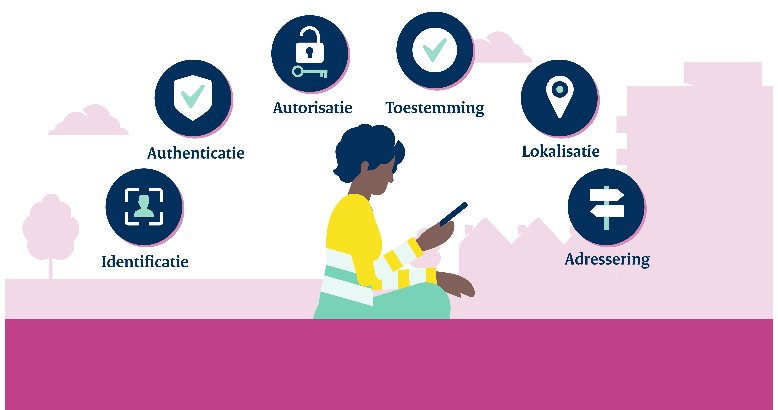
The idea is that instead of every use case (eOverdracht, PZP, BgZ, ..) solving the same infrastructure problems from scratch, a shared foundation handles them once. Those shared capabilities are the Generic Functions, and they cover things like addressing, routing, localization, consent, identification, authentication, and authorization.
The specification is published here: https://minvws.github.io/generiekefuncties-docs/
What They Cover
At a high level:
Addressing and Routing handle the where and what. A national Care Services Directory (built on IHE mCSD) lets any system discover care providers, their services, and their digital endpoints. Routing builds on top of that to select the right destination for a referral or order.
Localization (the Nationale Verwijs Index) answers the question "which organizations hold data about this patient?". It does this through a dedicated Pseudonymisation function, which is a national Pseudonymisation Register Service ( PRS) that converts the BSN into recipient-scoped pseudonyms using HKDF and OPRF blinding, so no single party ever sees the raw identifier. Different recipients receive different pseudonyms from the same BSN, preventing cross-service correlation. The PRS itself stores nothing and every response is a single-use JWE encrypted to the recipient's public key. The NVI therefore never exposes the raw patient identity, and neither does any intermediate hop in the chain.
Consent unifies three models: national preference registry (Mitz/OTV), decentralized local consent storage (DHTV), and implicit consent.
Identification, Authentication, and Authorization form the security stack. Identification standardizes which identifier applies to which entity (BSN for patients, URA for organizations, UZI/DEZI for practitioners). Authentication is built on W3C Decentralized Identifiers and Verifiable Credentials. Authorization uses policy-based access control with Rego as the mandatory policy language.* (*proposal phase)
Infrastructure vs a Data Model
Generic Functions do not care what format your clinical data lives in. They care about how systems find each other, how consent is checked, how identities are verified. The data model underneath is your business.
An openEHR CDR participates in this ecosystem by exposing an API. The Generic Functions infrastructure sees that API, registered in the Care Services Directory, operating under the shared consent and authentication framework. What is really behind that endpoint, be it openEHR, XDS, FHR, a proprietary schema, it really doesn't matter for the generic function (with some nuances where it does matter, when you start applying smart on fhir scopes etc, but perhaps more on that at some other time).
openEHR Behind Generic Functions - How It Actually Works
So what does an openEHR-based system need to do to participate?
Addressing: your system registers an openEHR endpoint in an Administration Directory with a URA identifier. The national Update Client picks it up and consolidates it into the Query Directory. Any other system can then discover you via mCSD queries and your openEHR CDR is now visible to other participants via your AQL endpoint, Composition endpoint or perhaps a FHIR endpoint if you're leveraging FHIRConnect for mapping between one and the other.
Localization: when your CDR holds data relevant to a patient, you register a localization record in the Nationale Verwijs Index. Meaning you specify for which care context you're holding data of a specific patient and that's it. openEHR, FHIR, XDS, .. makes no difference, but it is an integration point for you as an openEHR vendor to make, as you need to publish a localization record in the NVI.
Consent: before serving any data, your system needs to actively query Mitz to verify that the patient has given consent for the requesting party. Meaning your openEHR stack needs to wire in a Mitz consent evaluation call as part of its authorization flow.
I demonstrated this end-to-end in the eOverdracht hybrid architecture PoC: EHRBase running as the openEHR CDR on the sending side, Firely Server handling the FHIR operational layer and mCSD models, openFHIR doing the bidirectional mapping, and the mCSD/Routing generic functions handling discovery and addressing. The receiving side was pure FHIR and it had no idea the sender was openEHR-backed.
Why openEHR Vendors Should Pay Attention
The Generic Functions program is not specifically about FHIR. It is about national infrastructure that any health data exchange use case in the Netherlands will eventually plug into, whether that exchange uses FHIR, XDS, openEHR APIs, or something else entirely. Addressing, consent, localization, authentication are all problems need to be solved regardless of what format the data travels in.
Right now, the use cases being tested are heavily FHIR-oriented, which reflects where most active Dutch use cases (eOverdracht, BgZ, PZP) currently live. But the underlying functions are format-agnostic, and the landscape is broader than FHIR alone. Ministry PoCs did test this on imaging exchange as well, for example (XCA-I).
For openEHR vendors operating in the Netherlands, this is worth following. Mainly because we believe Generic Functions will increasingly become the assumed baseline for national health data exchange. Use cases that currently feel distant will start requiring addressing registration, NVI localization records, and Mitz consent integration. Getting familiar with what that means for an openEHR stack, and where the integration points are, is a reasonable thing to do sooner rather than later.
If you are building on openEHR and want to understand how your system fits into the Generic Functions landscape, or if you need a proof-of-concept for your specific use case, feel free to reach out at syntaric.com.